
troubleshooting
Garage Refrigerator Winter Troubleshooting Guide 2026
Garage refrigerator winter troubleshooting for Twin Cities homes: why fridges quit below 38F, garage-ready kits, fixes, and when to call a pro.
June 21, 2026
Last verified
In this article(9)
- The 30-second diagnostic
- Why your garage fridge stops cooling in winter
- Manufacturer minimum operating temperatures (2026)
- The five real fixes (in order of cost)
- What about garage freezers (chest and upright)?
- The trap: a real failure that looks like a winter problem
- What it costs to fix in the Twin Cities (2026)
- Frequently asked questions
- When to call a Twin Cities tech
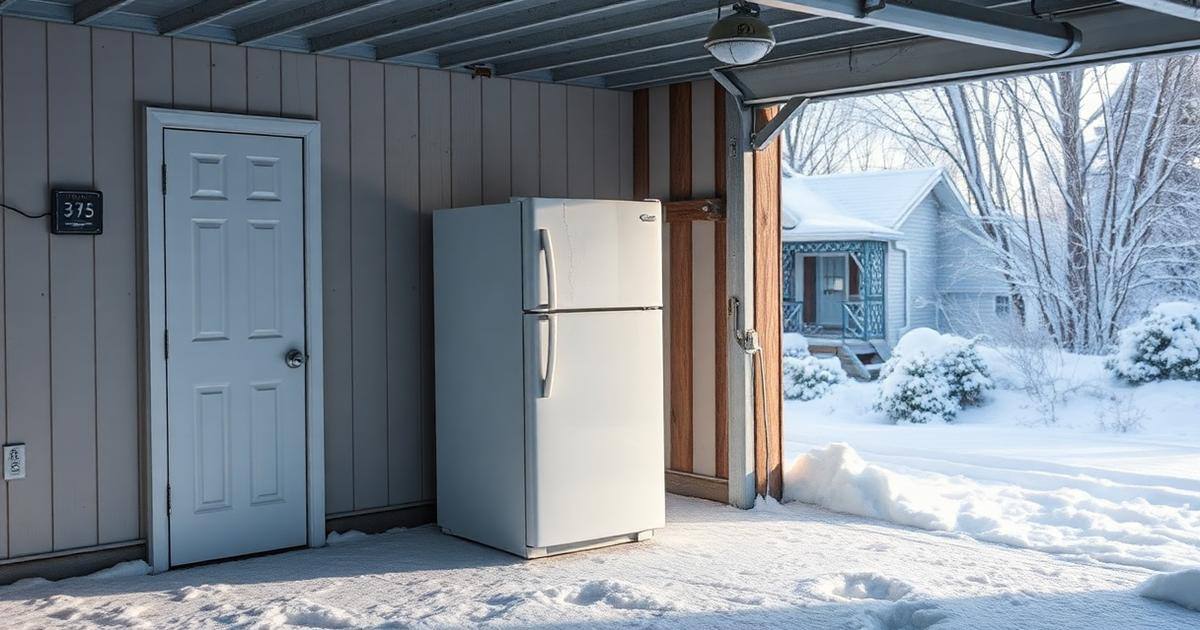
Garage refrigerator winter troubleshooting almost always comes down to one question: why did a fridge that worked fine all summer suddenly stop cooling once the garage dropped below 38°F? The short answer is that the thermostat thinks the appliance is already cold enough and never tells the compressor to run — so the freezer slowly warms up and it looks like the unit failed. It almost never has. This is the guide we hand to every Twin Cities, Hudson, and Prescott homeowner who calls us between November and March.
The 30-second diagnostic
- Put a thermometer in the fresh-food side and one in the freezer. Wait 4 hours.
- If both compartments are warmer than 40°F / 10°F and the compressor never ran during that window, you have the classic winter-shutoff problem.
- If only the freezer is warm but the fresh-food side is cold and the compressor is running, that's a real defrost or evaporator-fan failure — not a winter problem. Book a refrigerator repair.
- If both compartments are cold but the unit cycles oddly, leave it alone — it's fine.
- If you hear a click every 4–8 minutes from the back of the fridge, jump to the relay section below — that's a real failure, not the weather.
Why your garage fridge stops cooling in winter
A standard kitchen refrigerator has one temperature sensor on the fresh-food side and one compressor that serves both compartments. The freezer's temperature is controlled indirectly by an air damper that opens and closes to share cold air. When the fresh-food sensor never calls for cooling — because the garage is already 35°F — the compressor never runs, no new cold air is generated, and the freezer slowly drifts up to ambient. Most major brands (Whirlpool, GE, Frigidaire, Samsung, LG) work this way on freestanding top-freezer, bottom-freezer, side-by-side, and French-door models. The thermostat is doing exactly what it was designed to do for a 60–80°F kitchen.
Manufacturer minimum operating temperatures (2026)
- Whirlpool / Maytag / Amana — most freestanding models rated for 55°F–110°F ambient. Below 55°F is out of spec.
- GE / Profile / Café — typically 55°F–110°F; commercial-grade Monogram built-ins go lower.
- Samsung — 50°F–110°F for most French-door / side-by-side units; inverter boards do not tolerate cold-soak cycling.
- LG — 55°F–110°F for most consumer models. LG Linear Compressor units are especially sensitive to long off-cycles in the cold.
- Frigidaire / Electrolux — 55°F–110°F; the Frigidaire Garage Ready FFHT/FFTR line is a real exception and works to 0°F.
- Sub-Zero built-ins — the only consumer line we routinely see hold setpoint reliably in unconditioned garages, because they use independent compressors for each compartment.
The five real fixes (in order of cost)
- Heat the garage above 40°F. Cheapest fix. A 1,500W garage heater on a thermostat runs about $0.30–$0.60/day during a Twin Cities cold snap.
- Insulate around the fridge. Surrounding a freestanding fridge with foam board and weather-stripping the compartment around it keeps it 10–15°F warmer than the open garage. Works down to roughly 25°F ambient. Cost: $40–$120 in materials.
- Install a garage-fridge kit. Whirlpool, GE, and Frigidaire sell garage-ready conversion kits (typically $30–$80 parts, $150–$220 installed) — a small heater wired near the thermostat tricks the sensor into calling for cooling. Verify your specific model number is supported before buying; many newer inverter-board models are not.
- Buy a garage-rated fridge. If you replace, look for "garage-ready" in the spec sheet. The 2026 GE Garage Ready line (GTE / GIE models), Gladiator chest freezers, and Frigidaire's garage-ready uprights are the proven options in Minnesota and Wisconsin. Plan on $700–$1,400 for a quality unit.
- Move the fridge into conditioned space. A mudroom, basement, or insulated workshop with year-round heat solves the problem permanently.
What about garage freezers (chest and upright)?
Standalone freezers have the opposite problem — they handle cold ambient temperatures much better because their thermostat is reading the freezer compartment directly (already 0°F), and below-freezing ambient air just means the compressor runs less. Most chest freezers operate down to 0°F ambient without issues; uprights with auto-defrost can struggle below 32°F because the defrost heater needs to actually warm and re-cool the coils, which doesn't complete properly when the room is freezing. Standalone freezer repair pricing here.
The trap: a real failure that looks like a winter problem
Two failures look identical to the winter-shutoff problem and we see them every January:
- Failed thermistor (sensor): the sensor reads a permanently wrong temperature. The compressor either never runs or never stops. A real thermistor failure shows up year-round — but it's easy to blame the cold weather when it starts in November. Repair: $180–$320.
- Failed start relay / PTC: the compressor tries to start but can't. You'll hear a clicking sound every 4–8 minutes. Repair: $160–$280.
- Stuck damper: if the fresh-food side is fine but the freezer is warm even when the compressor runs, the air damper between compartments is iced or jammed. Repair: $190–$340.
If you're not sure which one you have, the 30-second diagnostic above will tell you in 4 hours.
What it costs to fix in the Twin Cities (2026)
- Diagnostic / trip fee: $149, waived with approved repair.
- Thermistor or temperature-sensor replacement: $180–$320 all-in.
- Start relay / PTC + capacitor: $160–$280.
- Evaporator fan motor: $220–$380.
- Defrost heater or defrost thermostat: $190–$340.
- Garage-ready kit install (on supported models): $150–$220.
Frequently asked questions
Will leaving a light bulb on inside the garage fridge help? Marginally, on older mechanical-thermostat models. Modern thermistor-based fridges ignore radiant heat from a bulb. Don't rely on it.
Will my fridge break if I run it in a cold garage? Usually no — it just stops cooling correctly. The exception is LG Linear Compressor and Samsung digital-inverter units, which can develop oil-migration issues from very long off-cycles below 30°F.
Is a chest freezer a better choice for a Minnesota garage than an upright? Yes. Manual-defrost chest freezers tolerate sub-zero ambients far better than auto-defrost uprights.
Can I just turn the fridge colder? No. The thermostat is comparing the compartment temperature to ambient air, not to the dial setting. Turning it to "coldest" does nothing when the room is already below the setpoint.
How long should I wait before calling a tech? Run the 4-hour diagnostic above. If the compressor never runs and the garage is below 40°F, it's a winter problem, not a repair. If the compressor runs and one compartment is still warm, call.
When to call a Twin Cities tech
Call us if (a) the diagnostic above shows the compressor isn't running but the garage is above 50°F, (b) you hear repeated clicking from the compressor area, (c) the freezer is warm but the fresh-food side is cold, or (d) a previously fine fridge stopped working in the garage before winter temperatures arrived. We charge a flat $149 trip-and-diagnostic fee, waived when you approve the repair. Book online or call (651) 364-7466. Service area: Minneapolis, St. Paul, Woodbury, Stillwater, Hudson WI, Prescott WI, and the east-metro suburbs.
Frequently asked questions
Quick answers
What about garage freezers (chest and upright)?
Standalone freezers have the opposite problem — they handle cold ambient temperatures much better because their thermostat is reading the freezer compartment directly (already 0°F), and below-freezing ambient air just means the compressor runs less. Most chest freezers operate down to 0°F ambient without issues; uprights with auto-defrost can struggle below 32°F because the defrost heater needs to actually warm and re-cool the coils, which doesn't complete properly when the room is freezing. Standalone freezer repair pricing here .