
Commercial Repair
Commercial Range Repair: Burner, Pilot and Valve Fixes
Commercial range repair guide: burners that will not light, yellow flames, stuck valves, oven section faults, and Twin Cities pricing.
July 29, 2026
Last verified
In this article(14)
- Read the flame first
- Burner will not light
- Stiff or leaking valves
- The oven section under the range
- What operators should not touch
- What this repair costs in 2026
- Safety rules before you open anything
- Frequently asked questions
- Why will my commercial range burner not light?
- Why is my range flame yellow instead of blue?
- Why are my burner knobs so hard to turn?
- How often should a commercial range be serviced?
- What does commercial range repair cost in the Twin Cities?
- Related commercial service pages
This guide answers the questions Twin Cities kitchen operators ask most about commercial range repair, with 2026 pricing, step-by-step triage, and a clear line between what your team can fix tonight and what needs a certified commercial technician.
Quick answer: Commercial range repair usually means burner ports, pilots, and valves. A burner that will not light has clogged ports or a dead pilot. A yellow, lazy flame means the air shutter is closed or the ports are fouled - a correct flame is blue with a defined inner cone. Stiff knobs mean a valve needs regreasing, not replacing. Oven-section faults follow the same order: gas, pilot, thermostat.
Read the flame first
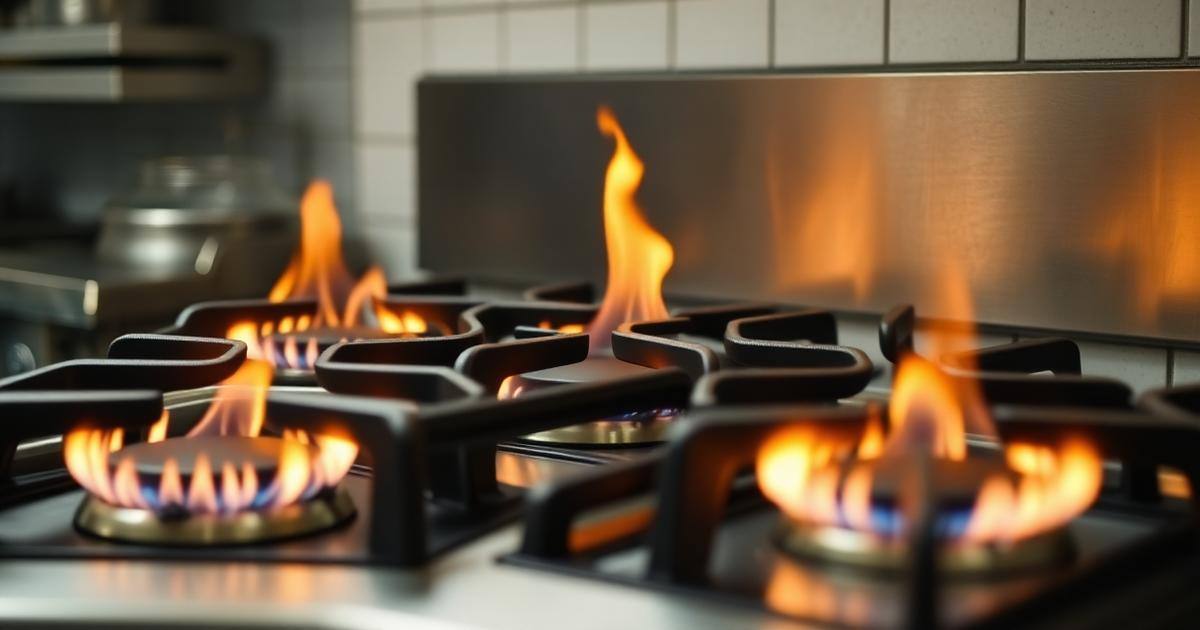
Flame quality tells you almost everything. A healthy open burner produces a crisp blue flame with a distinct inner cone and no yellow tipping. Yellow, lazy flames mean incomplete combustion: the air shutter is closed too far, the ports are partly blocked with carbonized spill, or the burner is starved for gas. Incomplete combustion also produces carbon monoxide, so it is a safety issue and not just a cooking one.
Burner will not light
Lift the burner grate and head. Look at the pilot - on standing-pilot ranges each pair of burners shares one. If the pilot is out, relight it and adjust the flame until it is about a quarter inch and steady. If it will not stay lit, the pilot orifice is plugged with grease or the pilot tube is kinked.
With the pilot burning, clean the burner ports and the flash tube that carries flame from the pilot to the burner. A blocked flash tube is the most common reason one burner lights on the second try while its twin lights instantly.
Stiff or leaking valves
Knobs that take two hands are not broken - the valve grease has dried. A technician can disassemble, clean, and regrease most commercial burner valves for far less than a replacement. Never force a seized valve; twisting the stem can crack the body and create a gas leak.
Any smell of gas with all knobs off means stop. Close the wall valve, ventilate, and call the utility and a gas-certified technician.
The oven section under the range
Standard and convection oven bases share the same failure list as standalone commercial ovens: pilot or igniter, thermostat drift, and door gaskets. Verify cavity temperature at 350 F with a probe thermometer after a 30-minute soak. Drift over 25 F means calibration or a probe. Check the door hinge springs too - a base oven door that hangs open half an inch will never hold temperature.
- Clean burner ports monthly with a wire brush.
- Pull and degrease the drip trays weekly.
- Verify each pilot after every deep clean - water kills pilots.
- Confirm hood filters are clean so the range gets combustion air.
What operators should not touch
Gas valves, manifold pressure, thermostat replacement on gas ovens, and any work on the flue or hood interlock belong to a gas-certified commercial technician. Insurance carriers and most Minnesota municipalities require documented professional service on gas-fired kitchen equipment.
What this repair costs in 2026
ServiceTypical rangeCommercial diagnostic (applied to repair)$199Burner port cleaning and pilot service$185 - $345Burner valve rebuild or regrease (per valve)$145 - $265Oven thermostat replacement$385 - $685Gas valve or safety valve replacement$585 - $1,050Pricing reflects standard business hours in the Minneapolis and Saint Paul metro. Every job is quoted in writing before work begins, and the commercial diagnostic is credited toward the repair.
Safety rules before you open anything
- Close the wall gas valve before any burner or pilot work.
- Do not force a seized valve stem - cracking the body creates a gas leak.
- Yellow flames mean incomplete combustion and carbon monoxide risk; fix them immediately.
- Confirm the hood is running before lighting pilots after service.
Frequently asked questions
Why will my commercial range burner not light?
Either the shared standing pilot is out or the burner ports and flash tube are clogged with carbonized spill. Relight and adjust the pilot to a steady quarter-inch flame, then clean the ports and flash tube with a wire brush.
Why is my range flame yellow instead of blue?
Yellow flames mean incomplete combustion from a closed air shutter, blocked ports, or insufficient combustion air with the hood running. It wastes gas, sooties pans, and produces carbon monoxide, so correct it before the next service.
Why are my burner knobs so hard to turn?
The valve grease has dried out. Most commercial burner valves can be disassembled, cleaned, and regreased for far less than replacement. Never force a stuck stem, because cracking the valve body creates a gas leak.
How often should a commercial range be serviced?
Clean burner ports monthly in-house and schedule professional service twice a year to check pilots, valves, oven calibration, and combustion. High-volume kitchens benefit from quarterly visits.
What does commercial range repair cost in the Twin Cities?
Our commercial diagnostic is $199 and applies to the repair. Burner and pilot service runs $185 to $345, valve rebuilds $145 to $265 each, oven thermostats $385 to $685, and gas valves $585 to $1,050.
Related commercial service pages
- Commercial oven repair Minneapolis
- Commercial range repair
- Commercial oven repair
- Commercial bakery oven repair
- Commercial appliance repair Saint Paul
- Commercial appliance repair in the Twin Cities
Central Minnesota Appliance Repair services restaurants, bars, breweries, grocery, convenience stores, schools, and senior living across Minneapolis, Saint Paul, and the surrounding metro. Call (651) 364-7466 for commercial dispatch, including after-hours emergency service.
Frequently asked questions
Quick answers
Why will my commercial range burner not light?
Either the shared standing pilot is out or the burner ports and flash tube are clogged with carbonized spill. Relight and adjust the pilot to a steady quarter-inch flame, then clean the ports and flash tube with a wire brush.
Why is my range flame yellow instead of blue?
Yellow flames mean incomplete combustion from a closed air shutter, blocked ports, or insufficient combustion air with the hood running. It wastes gas, sooties pans, and produces carbon monoxide, so correct it before the next service.
Why are my burner knobs so hard to turn?
The valve grease has dried out. Most commercial burner valves can be disassembled, cleaned, and regreased for far less than replacement. Never force a stuck stem, because cracking the valve body creates a gas leak.
How often should a commercial range be serviced?
Clean burner ports monthly in-house and schedule professional service twice a year to check pilots, valves, oven calibration, and combustion. High-volume kitchens benefit from quarterly visits.
What does commercial range repair cost in the Twin Cities?
Our commercial diagnostic is $199 and applies to the repair. Burner and pilot service runs $185 to $345, valve rebuilds $145 to $265 each, oven thermostats $385 to $685, and gas valves $585 to $1,050.
Related repair services
Need this repaired professionally?
This guide pairs with our same-day in-home repair service. Same techs, OEM parts, 1-year warranty.