
Commercial Repair
Commercial Griddle Not Heating Evenly? Cold Spots, Valves & Costs
A commercial griddle that heats unevenly is diagnosed by mapping the plate with an infrared thermometer at 350°F. One cold zone points to a burner, valve or thermostat bulb; uniformly low heat points to gas supply; waves in the plate mean warping from thermal shock. Scrape and season daily, and never cool a hot plate with cold water.
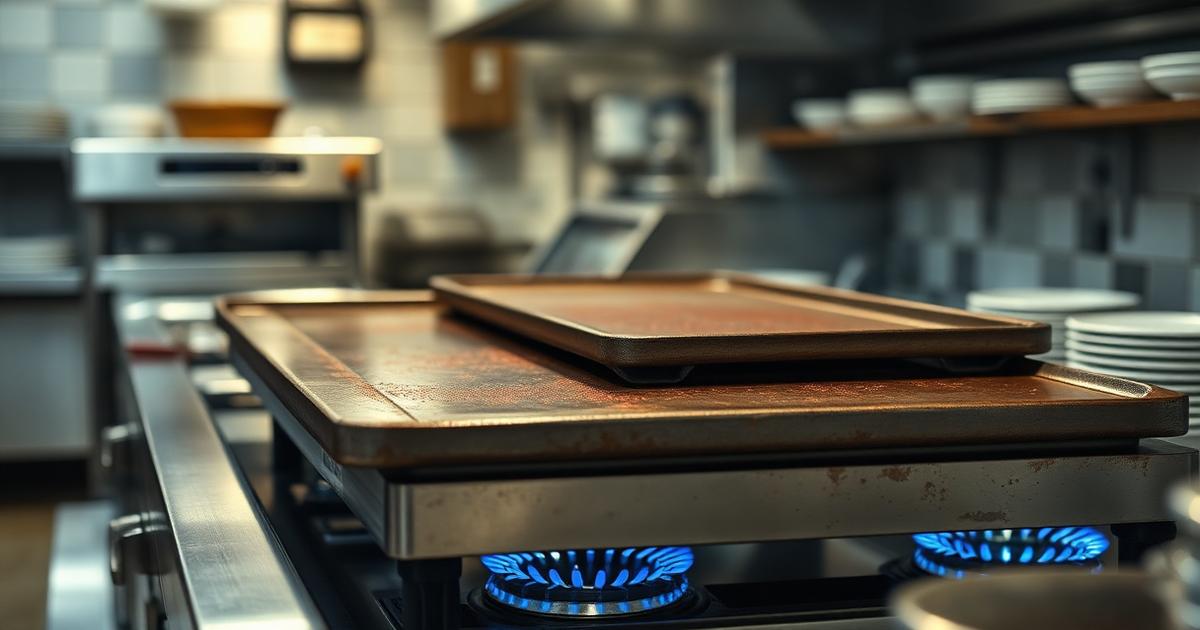
Map the plate before you diagnose
Set every zone to 350°F, let the griddle stabilize until the thermostats stop cycling, then take infrared readings on a grid across the plate. Write the numbers down. A healthy plate reads close to the same across a zone and close to the dial. A single cold quadrant tells you which burner or valve to inspect. Uniformly low readings across all zones point at gas supply, not at any one component.
Single cold zone: burner, valve, or bulb
Look at the flame under that zone through the burner viewing opening if your model has one; do not remove panels while the burners are lit. A weak, yellow, or partly lit flame usually means clogged burner ports, because carbon and grease drip into them for years. Burner removal and port cleaning on a gas griddle are technician work, done with the wall gas valve closed and with the port-cleaning tool or bit size the manufacturer specifies.
If the burner does not light at all, check the pilot for that section and the thermostat's sensing bulb clamped to the underside of the plate. Griddle thermostats read the plate through a bulb on a thin capillary tube, and a bulb that has worked loose from its clamp reads air temperature instead of plate temperature, so the burner shuts off early. It feels exactly like a dead thermostat, and a technician can often re-seat the bulb instead of replacing the thermostat. Do not kink or pinch the capillary tube while you look.
Whole griddle runs cool
When every zone is well below setpoint, look at supply. A shared gas line feeding a new fryer or a broiler installed later can starve the griddle during peak. Have a technician check manifold pressure with all appliances firing, not just the griddle alone. Regulators can also drift with age, and regulator work is a technician job.
Warped plates and thermal shock
Cold water on a hot plate can warp the steel. Once the surface dips, oil pools, eggs slide, and contact cooking becomes uneven no matter what the burners do. Prevent it: scrape while hot, deglaze with warm water only, and let the plate cool naturally before deep cleaning. Severely warped plates can sometimes be resurfaced, but replacement is often the honest answer.
- Scrape after every rush with a flat blade, not a chisel.
- Season with a thin film of high-smoke-point oil at close.
- Pull and empty the grease trough daily. Overflow is a fire hazard.
- Check that the plate is level; a tilted griddle pools oil and cooks unevenly.
Charbroilers add two failure points
On charbroilers, radiants crack and burner ports clog faster because everything drips straight down. Replace cracked radiants promptly, because they distribute heat and their absence creates flare-ups and cold gaps. Empty and clean grease pans daily. Cooking is the leading cause of restaurant fires, according to the U.S. Fire Administration, and a full grease pan under a charbroiler feeds that risk.
What this repair costs in 2026
| Service | Typical range |
|---|---|
| Commercial diagnostic | $199 - $299, waived when you approve the repair |
| Burner cleaning and port service (per section) | $185 - $325 |
| Thermostat or sensing bulb replacement | $325 - $585 |
| Gas valve or regulator replacement | $585 - $1,050 |
| Griddle plate resurfacing or replacement | Quoted per model |
You approve a written quote before any burner, valve or plate work starts. The diagnostic that comes first is $199–$299, set by the type of equipment, and it is waived when you approve the repair; there is no separate trip fee.
Safety rules before you open anything
- Close the wall gas valve before removing panels or cleaning burners.
- Let the plate cool until it is safe to touch before deep cleaning, and never quench it with cold water.
- Empty grease troughs and pans daily and confirm hood filters are clean.
- If you smell gas, leave the building, don't operate switches or flames, and call your gas utility (CenterPoint Energy or Xcel Energy) or 911 from outside.
Commercial griddle not heating evenly: FAQs
Why does my commercial griddle have cold spots?
A single cold zone often means clogged burner ports, a failed section valve, or a thermostat sensing bulb that has come loose from the underside of the plate. Map the plate with an infrared thermometer at 350°F to identify which zone is affected.
Why is my whole griddle running cool?
Uniformly low temperature across every zone points to gas supply rather than the griddle. Manifold pressure can drop when a fryer or broiler was added to the same line later. A technician should check pressure with all appliances firing.
Can a warped griddle plate be fixed?
Light warping can sometimes be resurfaced by a machine shop, but plates warped by repeated cold-water quenching usually need replacement. Prevent it by scraping hot, deglazing with warm water only, and letting the plate cool naturally.
How often should a commercial griddle be serviced?
Follow the schedule in the manufacturer's manual for burner cleaning and thermostat calibration, and shorten it for a high-volume kitchen. Daily scraping, seasoning, and grease-trough emptying prevent many of the failures that produce service calls.
Why is my charbroiler not getting hot or cooking unevenly?
Cracked or missing radiants, clogged burner ports or low gas supply are the usual causes. Cracked radiants leave cold gaps and cause flare-ups, so replace them promptly with the burners off, the gas valve closed and the unit cool, and leave burner port cleaning to a technician.
Do charbroiler radiants need replacing?
Yes, when they crack, break or burn through. They distribute heat evenly, and a missing or cracked radiant leaves uneven char and flare-ups.
What does commercial griddle repair cost?
The diagnostic visit is $199–$299 depending on the equipment and is waived when you approve the repair. Burner cleaning runs $185 to $325 per section, thermostats $325 to $585, and gas valves or regulators $585 to $1,050, quoted in writing before work begins.
Related commercial service pages
- Commercial range repair
- Commercial oven repair
- Commercial appliance repair Minneapolis
- Commercial appliance repair in the Twin Cities
Send us your infrared readings when you call (651) 364-7466; we book griddle and charbroiler visits 7am to 9pm every day across the Twin Cities.
How do I tell a gas supply problem from a burner problem?
Look at the pattern across the plate. One cold zone points to that section's burner, valve or thermostat bulb. Every zone running low points to gas supply or a drifting regulator, especially if another appliance was added to the same line.
Take infrared readings on a grid at 350 F before you touch anything, and write them down. Central Minnesota Appliance Repair uses that kind of map to decide what to check first. Call (651) 364-7466 for a written quote before any work.
Which griddle and charbroiler faults can staff handle?
| Symptom | Likely cause | Who handles it |
|---|---|---|
| Single cold zone | Clogged ports, section valve or loose bulb | Technician cleans ports and checks the valve |
| All zones cool | Gas supply or regulator | Technician checks manifold pressure |
| Waves in the plate | Thermal shock warping | Resurface or replace the plate |
| Repeated flare-ups | Full grease pan or cracked radiants | Staff empty pan; replace radiants |