
Commercial Repair
Restaurant Refrigeration Failure: First Hour Checklist
A restaurant refrigeration failure gives you two jobs at once: protect the food, and get a qualified technician looking at the unit. We repair commercial refrigeration across Minneapolis and Saint Paul, and we're open 7am–9pm every day, with same-day appointments available. The sequence below is the one we would hand to any kitchen manager: log temperatures, keep doors shut, move what you can, then call a company that works on sealed refrigeration systems.
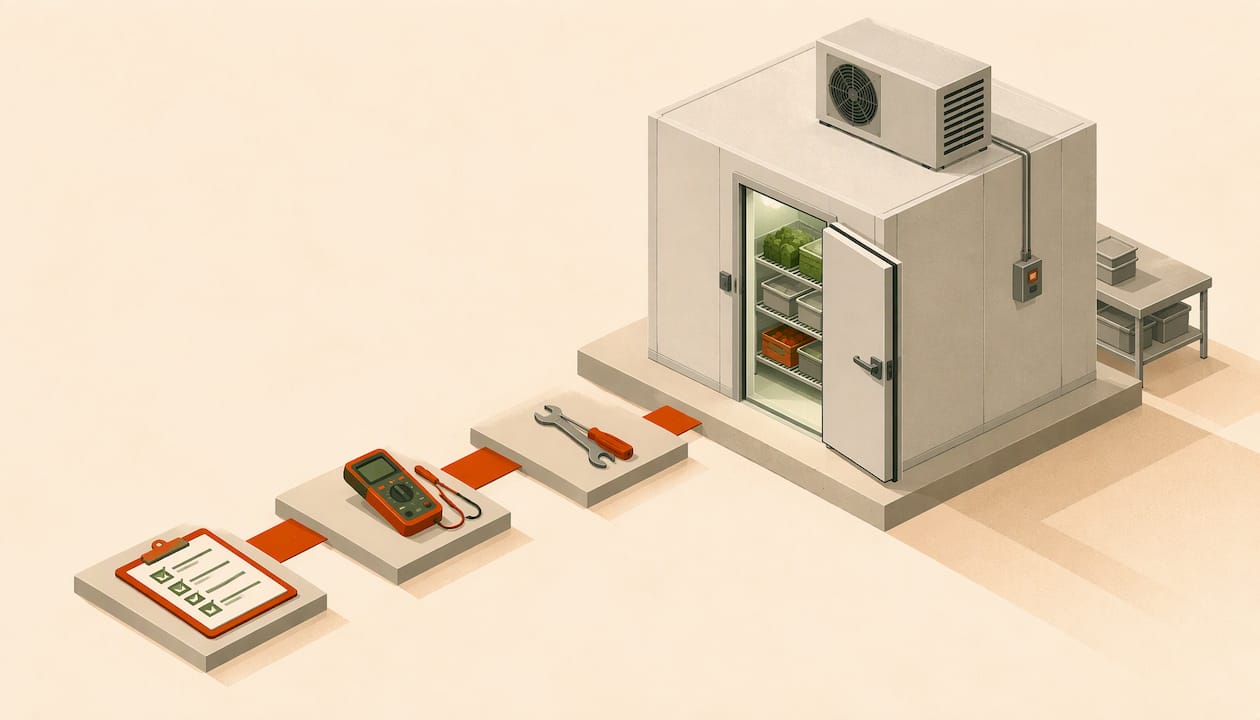
The short version
- Write down when you found the failure and log food temperatures right away.
- Keep doors closed, move high-risk food to working units or ice, and keep logging temperatures.
- Call a commercial refrigeration technician, not a general handyman, and ask when they can get to you before you ask about price.
- Commercial visits start with a diagnostic of $199–$299 depending on the equipment, waived when you approve the repair.
- Decide repair or replace on the repair quote, the unit's age and the cost of downtime, not on a single rule of thumb.
The first 30 minutes: protect the food
The repair can wait a few minutes. The food log cannot. Health departments judge discarded product by how long it sat warm, and you can only show that if you wrote it down.
- Record the time. Note when you found the unit warm or the power off, and take food temperatures with a probe thermometer. Write every reading down.
- Keep doors closed. Every opening lets cold air out. Only open a unit to move product, and check cold food at regular intervals.
- Know the cold-holding line. The FDA Food Code sets cold holding for time/temperature-controlled food at 41°F or below. How long food may sit above that before it must be discarded is set by your local health department, so ask them in advance. If you do not know how long the box has been warm, treat the food as unsafe.
- Triage by risk. Check meat, poultry, seafood, dairy, cut produce and cooked foods first. Document anything you throw out.
- Move or ice what you can. Put high-risk items in a working cooler, or surround them with ice. Group cold packages together, keep raw meat separate and cover open display cases. If you use dry ice, handle it with gloves, keep it off direct contact with food, and never put it in a walk-in or any closed space people enter: the carbon dioxide it gives off can build up to dangerous levels.
- Never cool hot food in a dead unit. Hot items in a non-working cooler warm everything around them.
Assign roles if you have staff
In a busy kitchen, one person owns the thermometer log, one owns the phone and one moves product. Decide in advance where you would get ice, totes or a refrigerated truck. If you have never written that down, do it this week, before the next failure.
When to stop serving
If you cannot hold safe temperatures, stop serving the affected food. If you are unsure whether a failed cooler requires you to stop handling food or notify anyone, call your local health department.
Who to call after a restaurant refrigeration failure
A walk-in compressor, a reach-in with a failed condenser fan and an ice machine that will not harvest are all refrigeration problems, but they are different repairs. The first call should go to a company that works on commercial refrigeration. Our commercial refrigeration repair page covers what we handle, and the wider restaurant equipment repair page covers the rest of the kitchen.
When you call, have this ready:
- Type of unit: walk-in, reach-in, prep table, undercounter, ice machine, beverage dispenser.
- Brand and model, from the data plate.
- What you see: warm box, running but not cooling, iced-up evaporator, no power, unusual noise, water on the floor.
- The temperature your thermometer shows now, and since when.
- Whether you have a backup unit or need to protect product right away.
Then ask when they can get to you and what the diagnostic costs. For us, commercial service starts with a diagnostic of $199–$299 depending on the equipment, waived when you approve the repair. You get a written quote before any repair work, and every completed repair is backed by a written 1-year parts-and-labor warranty.
What a technician checks
A good visit is a method, not a guess. The technician works through a short list:
- Airflow and coils. Dirty condenser coils and failed fan motors are among the first things inspected, because they are quick to confirm and quick to fix.
- Electrical. Contactors, relays, capacitors and motors.
- Controls and defrost. A unit that ices up or short-cycles is often a controls or defrost issue rather than a dead compressor.
- Refrigerant circuit. Low charge points to a leak. Sealed-system work needs certified handling, and our technicians hold EPA Section 608 Universal certification for sealed-system refrigeration work.
- Door gaskets and hinges. Cheap parts that cost real money in lost cold air.
What the repair is likely to cost
Price depends on the unit, the fault and the part. These are our typical parts-and-labor ranges for cold-side equipment. The commercial diagnostic is $199–$299 depending on the equipment, waived when you approve the repair.
| Equipment | Typical repair range |
|---|---|
| Walk-in cooler or freezer | $385–$985 |
| Reach-in cooler or freezer | $285–$685 |
| Prep table and undercounter cooler | $285–$585 |
| Ice machine | $325–$780 |
Ranges are parts and labor and do not include the diagnostic. Compressor replacement and refrigerant leak repairs fall outside these ranges and are priced after diagnosis.
What moves the number, in plain terms:
- System type and size. A walk-in has more components and a bigger refrigerant circuit than a prep table.
- Fault. A fan motor or gasket is a small repair. A failed compressor is not.
- Parts availability. Older or specialty models can mean waiting on a part.
- Timing. Letting a small fault run tends to turn a minor repair into a spoiled-inventory problem.
The cost of a repair is rarely the biggest number in the room. Lost inventory and lost service hours usually are.
Repair or replace?
A quick reality check works better than a rule. Ask three questions:
- How old is the unit, and what has it needed already? A reach-in with repeated callouts is telling you something.
- What does the quote cover? A failed fan motor on a sound box is a different decision from a failed compressor on an old one.
- What does downtime cost you? Count spoiled product, lost covers, rental or loaner costs and your staff's time.
We give you the repair price after diagnosis so you can compare it with the cost of a new unit before you approve anything.
Catch the next failure before Friday night service
Many failures give warning signs first. Watch for:
- A box that takes longer to recover after busy service.
- Ice build-up on the evaporator or around the door.
- A compressor that runs constantly or cycles on and off.
- Dust-clogged condenser coils, a common cause of overheating.
- Cracked or loose door gaskets.
- Water pooling under the unit.
Keep a thermometer inside every cold unit and log it at opening and closing. A slow upward drift is cheap to catch and expensive to ignore. Our commercial refrigeration maintenance checklist lists the routine checks, and we offer commercial appliance maintenance for businesses that want them scheduled instead of waiting for a failure.
Equipment and brands we work on
Twin Cities kitchens run a mix of equipment. If yours is one of these, the dedicated pages explain the common faults:
- Walk-in cooler and freezer repair
- Ice machine repair
- Commercial freezer repair
- True refrigeration repair
- Beverage-Air refrigeration repair
- Continental refrigeration repair
By location: commercial refrigeration repair in Minneapolis and in Saint Paul.
If a unit is down right now
If a cooler, freezer or ice machine is down now, call us. We're open 7am–9pm every day and offer same-day appointments across Minneapolis and Saint Paul. The commercial diagnostic is $199–$299 depending on the equipment, waived when you approve the repair. We are rated 4.5 stars from 900+ reviews. Have your unit type, brand and current temperature reading ready, and book through our commercial appliance repair page or call (651) 364-7466.
FAQ
How long can food stay in a warm cooler?
The FDA Food Code sets cold holding at 41°F or below. The time limit above that is set by your local health department, so ask them before you need the answer. If you do not know how long the box has been warm, treat the food as unsafe.
Do you charge for the visit if I do not go ahead with the repair?
Commercial visits start with a diagnostic of $199–$299 depending on the equipment, waived when you approve the repair. If you do not approve the repair, the diagnostic is not waived. You get the repair price after diagnosis, before any work starts.
Can you fix both a walk-in and a reach-in on the same visit?
Yes. Tell us about every unit when you book so the technician has enough time. We repair walk-ins, reach-ins, prep tables, ice machines and beverage dispensers.